
This discussion + podcast is the LAST of a 10-part series that accompanies our book on SCI recovery, From the Ground Up: A Human-Powered Framework for Spinal Cord Injury Recovery.
It will introduce the uninitiated reader to topics discussed in Chapter 8 of the book, but some vocabulary or context may not be fully defined.
Effortless movement throughout the day is possible when your maximal abilities are much greater than the daily demands. So, effective functional loaded training goes beyond the necessary strength needed for regular activities, increasing the body’s capacity beyond what is required so these everyday activities are performed with ease. For example, a weightlifter doesn’t require all her strength to lift a heavy suitcase, but she can certainly do it more easily than someone who never lifts weights.
The last phase of our Framework for SCI Recovery strengthens the movement patterns discussed in Chapter 9 by adding load.
Adding load refers to the use of any challenge that increases the overall “volume” of effort to complete a movement. This can be in the form of adding weight, resistance, increasing set duration (endurance) or number of repetitions. In other words, loading the system is stressing the system beyond its everyday demands.
“Loading the system” comes after “building movement patterns in the Framwork, so generally we want to make sure that our movement patterns are smooth, efficient and self-supported before we try to make them harder with load. Afterall, loading an inefficient pattern usually results in more proficiency of that undesired pattern. Resist the urge to load an exercise for the “sake of making it more exciting” until the body is truly ready to take on that challenge. Recall the many options for challenging an exercise while maintaining it’s integrity in Chapter 8.
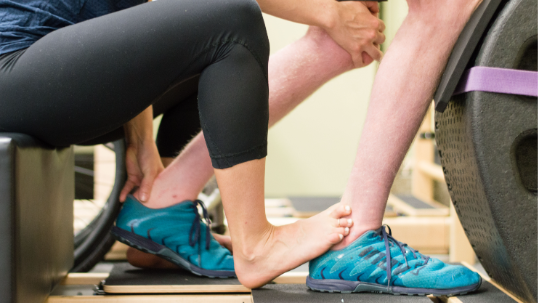
Create a sense of load without actually adding weights by applying pressure through the joints (here the ankle). This effect reflexively cues activation in a challenging area without complicating the posture and/or compromising form.
Loading informs neuromuscular patterning
Sometimes it is helpful to use load to help the body better understand the demands of a movement pattern. We can use the added challenge as a kinesthetic teaching tool (when used strategically!):
Weighted exercises inform movement pattern development in SCI rehab by:
Providing crucial proprioceptive feedback
Teaching reflexive integration and spontaneous organization of movement
Highlighting the need for foundational stability
Load provides crucial proprioceptive feedback. With a compromised sensory system, we need to leverage our ability to sense mechanical changes in fascial tension as a way to inform us about joints. We can induce these mechanical changes with the application of load or bearing our own weight through our limbs. Since the myofascia is what holds the tensegrity structure of the body together, adding load will require more tension to avoid collapsing. We can amplify proprioception for individuals with SCI and limited sensation by applying this load to the system.
Load induces integration and spontaneous organization of movement. When someone hands you a heavy box, your body stabilizes (stiffens) in anticipation, or at least upon the acceptance of the box. This happens through reflexive input from the spinal cord as well as "pseudo-voluntary" input from the brain. “Tissue-lengthening" (stretch) afferent signals are sent from tendons to the spinal cord, which sends back "contract" efferent signals to protect you from immediately collapsing with the weight of the box. The brain also receives afferent signals, and you instinctively respond by adjusting your body position to accommodate the new center of mass. This is "pseudo-voluntary" because it's more by instinct than conscious volition, but is not technically a spinal reflex.
Load highlights the need for foundations. Loading an exercise beyond an athlete’s current abilities (sometimes to failure) highlights stability requirements of more complex movements. This strategy is often a humbling experience, kinesthetically showing the athlete that more foundational stability is required. Discuss your reasoning for adding load, and the potential failure, beforehand so they recognize the struggle as educational rather than disappointing.
Explore these concepts in greater detail in our book, From the Ground Up: A Human-Powered Framework for Spinal Cord Injury Recovery, available in print & e-book format.

The joint-wise progression of load application
In order to draw connections along myofascial chains from connected to disconnected areas, we must pay close attention to where load is applied. If the resistance is applied across joints that have not yet achieved the ability to transmit forces, the body will not be able to create a force against the load. The movement will fall apart at these ‘unconnected’ joints.
Consider applying resistance to joints more proximal to the individual’s controlled areas for best results, and progressively include more distal joints as strength and integration increase.
Apply load in SCI strength training exercises by:
Load the exercise proximally, re-establishing connection here with increased resistance
Progress the point of loading distally, pausing wherever the athlete feels a loss of connection, or the pattern deteriorates
Increase the amount of load while maintaining proper form
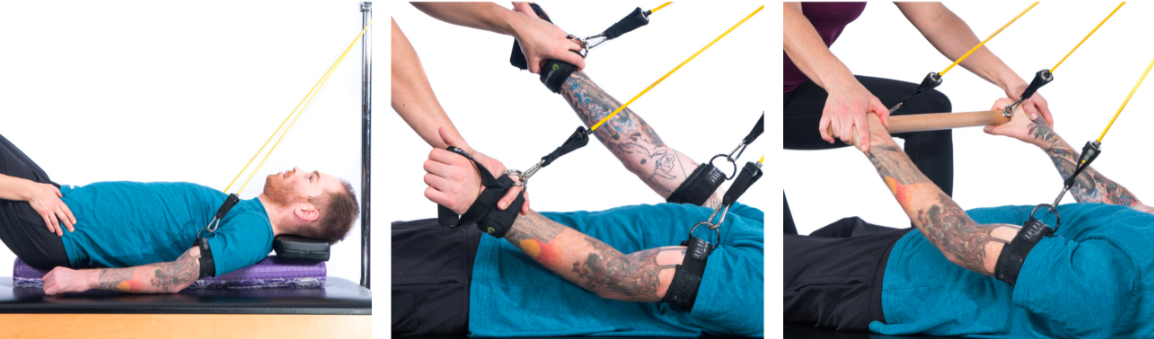
An example joint-wise loaded progression from 1.) scapular stability, then 2.) across the tricep and finally 3.) including the wrist joint. Notice how special attention is given to including just one additional joint in each step.
Adding load to exercises is what makes our movement patterns useful but we should be strategic in the application.
Whether you are adding load to cue the body in specific activation patterns or to simply increase the intensity of an exercise or posture, be mindful of where it’s applied so that strength is developed proximally to distally.
Supplement these chapter cliff notes with audio of Theo & Stephanie discussing these topics.

Chapter / Episode 10 topics include:
Different kinds of loading and their unique uses: increasing resistance, intensity, or endurance
Developing strength after spinal cord injury: muscle hypertrophy versus whole-body integration
When it is – and is NOT – appropriate to load a movement pattern prematurely
Spontaneous organization of support as a measure of progress
Loading of movements for able-bodied versus spinal cord injured individuals
Sign up for the FTGU Book Club to get these insights on spinal cord injury rehab delivered to your inbox every week, for ten weeks.