Each spinal cord injury is much too different from the next to have a singular system (read: there is no one-size-fits-all protocol for how to reconnect a paralyzed body!) - so, I believe that it’s important to have a diverse background in movement methods, philosophies and systems in order to best support to the individual in front of us.
Over the years and the many, many continuing education courses and books I’ve run through, I am [currently] drawn to FIVE systems/movement methods that seem to resonate best with my SCI clients.
>> I say ‘currently’ because I know this approach will always be evolving with the more I learn and grow!

These five systems are:
Nervous System Regulation
Motor Development Progression
Fascial Tensegrity
Pilates/Contrology
Bartenieff Fundamentals/Laban Studies
Within these five systems, I can emphasize a certain system that directly addresses their needs.
For example, someone with a spinal cord injury that also presents with high neurological tone might do better on an open floor mat on the floor, working through the familiar movements in the motor development progression (infant development), rather than restrict their movement further with the precision required in Pilates.
Before solidifying a recovery strategy, I need discover a few things about a person to determine how I will approach their program. Things like:
SCI presentation: high tone vs. low tone
Energy levels
Interests: appreciation for nuance?
Learning style
Familiarity (or unfamiliarity) with anatomy & bio-mechanics
These clues help me cater their program, and our interaction, to what their body - and mind - needs to succeed.
This article shares:
The established movement systems have shaped the Zebrafish Neuro Approach.
A description of each system, and why it is useful for recovery after spinal cord injury.
What types of clients I like using each applied system with.
Links to learn more about these systems.
A little back story.
Zebrafish Neuro co-founder, Theo St. Francis (C6 incomplete SCI athlete) found himself in quite the familiar predicament for most individuals with SCI, leaving the hospital thinking: “Now what?”
He then exhausted every ounce of what physical therapy and activity-based programming offered, but still felt a plateau in progress. One day he finally turned to me, his primary trainer at the time, and said: “Now what?”
Up until that point, we had always chalked it up to needing “more reps and more time! Just keep doing the same thing until something changes!”
But after a while, this didn’t sound much different to us than Einstein’s definition of insanity: doing the same thing over and over and expecting different results. Not only that, but it eliminated any control Theo had over his recovery process.
It was time for Theo, and many other clients who were not responding well to traditional protocols, to try another approach to healing and movement recovery.
You should also know that, at the time of this ‘awakening’ (circa 2013), the go-to programs for SCI recovery were very grounded in body-weight supported treadmill training. There was not much consideration for using movement methods that have a sound reputation for healing, or even the movement programs individuals engaged in before their injury, as an avenue for recovery and continued wellness programming.

So, we set out to study all sorts of movement methods and healing modalities including:
Pilates
Bartenieff Fundamentals/dance studies
Gyrotonics
Primal (Ido Portal-style) movement
Fascia: biotensegrity
Contractile field theory and “erectorcises”
Infant development progressions
Osteopathic medicine
PolyVagal Theory
These movement methods are already widely recognized, studied, and used globally. If they can successfully support healing and wellness in other populations, why not confidently use them for recovery after SCI?
From our exploration, we pulled what felt like the most relevant parts of each modality and curated a style of movement coaching and exercise execution that support movement re-discovery after spinal cord injury in the way we were designed to move: integrated.
… a high contrast to the use of robotics, external electrical stimulation, and isolated muscle training used in popular and traditional protocols.
The 5 Applied Systems we landed with:
Nervous System Regulation
Motor Development Progression
Fascial Tensegrity
Pilates/Contrology
Bartenieff Fundamentals/Laban Studies
Let’s take a look at each of these systems and how I have observed them support SCI athletes using them in their recovery programs:
Establishing a ‘healing state’ with Nervous System Regulation
You may have heard of different “nervous system states”: the sympathetic (“fight or flight”) state and the parasympathetic (“rest and digest”) state.
According to Polyvagal Theory, developed by Stephen Porges in the 1990s, the parasympathetic state does more than help us relax or digest food. It is the primary state that supports healing — both physical and emotional — as well as learning, processing trauma, and growth.
After neurological trauma (or any significant stress), the body can “store” that stress for years. This is the body’s way of preparing for the next potential threat. It operates from a “better safe than sorry” mindset, often holding protective patterns in the form of persistent muscle tension. Consciously, you may know the danger has passed. But the body remembers.
This understanding is key when we consider the root drivers of high tone and how we might help regulate it — without pharmacological intervention.
As Stanley Rosenberg writes in Accessing the Healing Power of the Vagus Nerve:
“When the [parasympathetic system] is withdrawn or decreased, then the system is optimized for defense, not healing.”
As neuro rehab clinicians who thoughtfully design session progressions, we can deliver the most textbook-perfect programming — but if the body in front of us is still in a defensive state, it is not primed for learning or integration. No matter how good the exercise selection is, it simply won’t land.
This means our first priority is not exercise selection. Our first priority is nervous system state.
We want to help the individual enter an “optimal healing mode” at the start of each session — sometimes through pre-session assignments, and always through intentional warm-up strategies that shift the nervous system toward safety.
Another important point: the more time someone spends in a parasympathetic state, the more resilient their system becomes. Stressful events will still happen. The nervous system may briefly shift into a sympathetic response — that’s normal. But with regulation skills in place, the body can return to baseline more quickly. Think: stress spike → recovery → back to steady. That flexibility is resilience.
One of the most accessible ways to influence the nervous system is through breathing. Breath is voluntary, yet it has powerful effects on involuntary processes like heart rate, blood pressure, muscle tone, and mental clarity. Even small changes in breathing patterns can shift physiological state. But breathing is just one tool.
Here are additional strategies that can help regulate nervous system state:
Specific body positions (especially when paired with intentional breathing)
Targeted self-pressure or gentle self-massage, particularly around the face, neck, hips, and abdomen
Rhythmic, repetitive movements, such as rocking, rolling, or twisting
These strategies — combined with mindful breathing — give us multiple entry points to support nervous system regulation. And when the nervous system feels safe, the body becomes more available for healing, learning, and meaningful movement change.
I use various strategies for NS regulation for clients who have:
Any residual somatic (body-stored) trauma - all SCI athletes!
High neurological tone - providing information to the body that relays the idea, “hey, you don’t need to be in protective response anymore.”
Those new to meditition practices, and may be too antsy for breathwork practices on their own - paired with movement or positions is a helpful gateway.
Stagnated energy that needs to be diffused.
>> Interested in learning how to support nervous system regulation (beyond breathing exercises)? Join me in an upcoming workshop! ⬇️

2. Foundations in the Motor Development Progression
Most of us have witnessed (in some capacity) the incredible process of an infant learning to move and coordinate their bodies in their first year or two of life. It’s an incredible journey that they fumble through, without the help of a training manual or coach, yet the process unfolds so beautifully bringing us from helpless bodies on our backs to dynamic beings walking, running, and playing around the house.
The Motor Development Progression (MDP) refers to the specific sequence of movements and positions that infants go through on their way to learning how to walk and run.
In a basic review, the positions are:

Of course, the MDP isn’t just the positions - it’s the little movements that happen within and between these positions that give this system the magic!
(Re-) learning movement through the MDP in this sequence ensures that no foundation is left unchecked.
The specific development of strength, mobility, and coordination learned at each phase ensures success in the next position. Without the foundations learned in, for example, supine, prone, and side-lying positions, there is just far too much going on in quadruped for us to introduce at once and keep track of.
We’re not naive to the fact that infants have fully intact nervous systems, and learning through the MDP at that age is a little different than using it for learning movement after SCI. However, it does provide insight into what foundational strengths need to be developed to be successful in others.
An exercise sequencing template, like the MDP, guides us in knowing WHAT EXERCISES TO DO, and in WHAT ORDER.
Our SCI athletes finally have a ‘map’ for their motor development trajectory with standards for when they can ‘graduate’ to the next level - they always know exactly where they are on that continuum and what they need to do to advance. What an empowering piece for SCI recovery plans!
I use the MDP and floor-based work with the following:
Clients with high neurological tone, due to the natural rotations and mobility involved.
Active, energetic-type clients that need to get their wiggles out!
Gait-focused programs, due to the progressive build to uprightness & reciprocal patterning.
Anyone interested in developing independence and home-based (out-of-wheelchair) exercise programs.
>> Interested in honing in our your floor-foundations to support ALL of your clients?⬇️

3. Body-Wide Connectivity & Stability brought to us by Fascia
The MDP lacks some nuance when it comes to body connection after paralysis: again, the MDP assumes a fully functioning nervous system.
This is where our fascia come into the picture.
A little background on fascia: Fascia is a type of connective tissue that surrounds every muscle, organ, bone, nerve, and vessel in our body. I think of it like Seran wrap: holding all of our bits together. Anatomists have known about fascia for a long time, but in the past, it’s been discarded in dissections as the annoying white fuzz that is in the way of the good stuff. Fascia has only recently been recognized and respected for its incredible functions including force transmission, joint stability, nerve conduction, and sensory information.
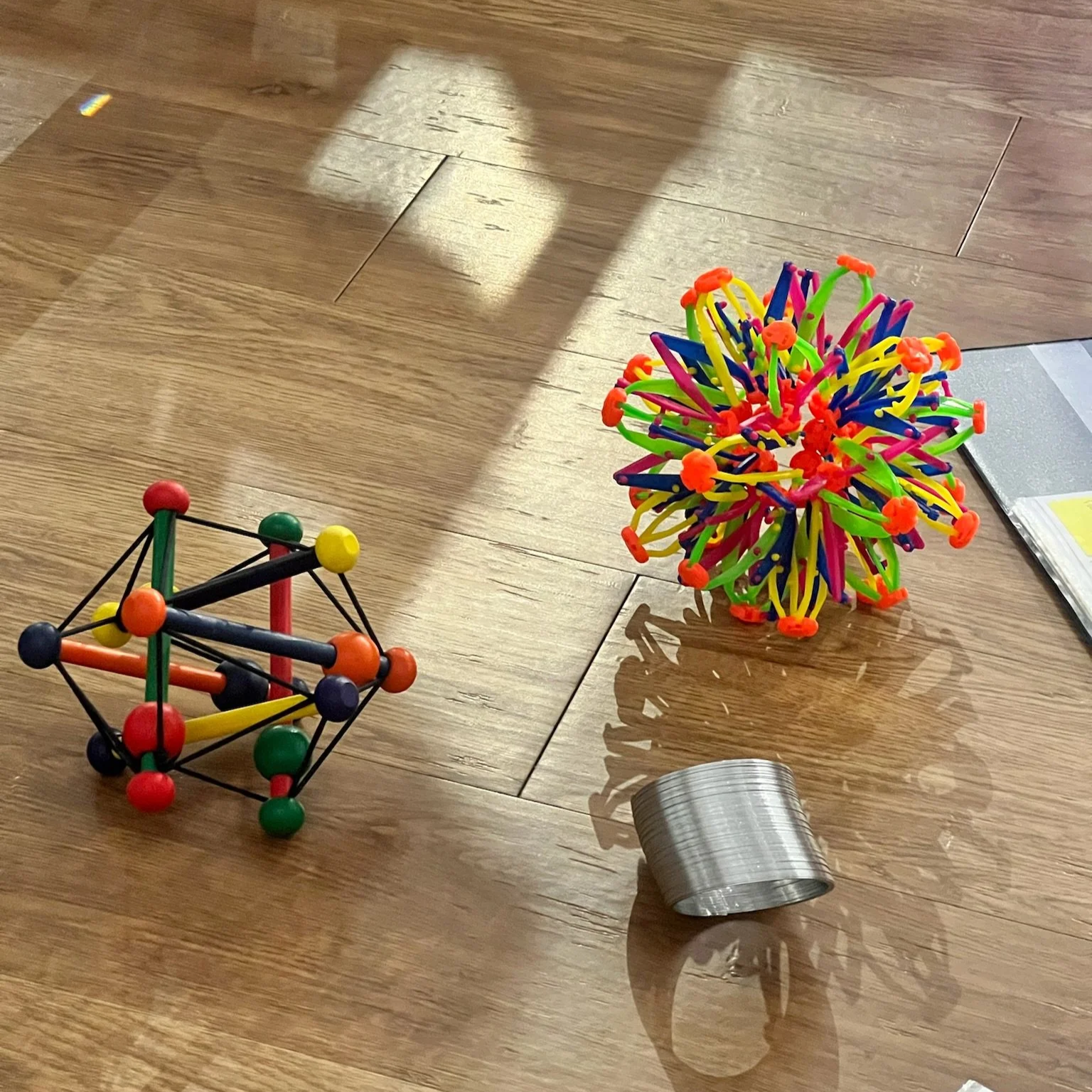
What makes fascia interesting for those with reduced muscle tone (due to spinal cord injury and/or muscle loss) is its material properties that offer an alternative source of structure and stability, for example, in our core and trunk. When we move in and leverage our fascia, we can hold our positions and postures with much less effort.
Fascia creates STABILITY.
You know how when you stretch an elastic tissue (like a muscle or a rubber band), the diameter of that tissue gets smaller? Smaller diameters of tissues (cross-sectional area) are generally weaker. Not ideal for our bodies to rely solely on this kind of tissue for joint structure, which is why we also have fascia surrounding each muscle.
When you stretch the fascia, the tissue expands, rather than getting smaller! This auxetic property allows us to generate tensile strength in our bodies without having to contract muscles. Pretty exciting for SCI athletes who have a hard time contracting muscles in the first place…
Fascial chains create CONNECTIVITY.
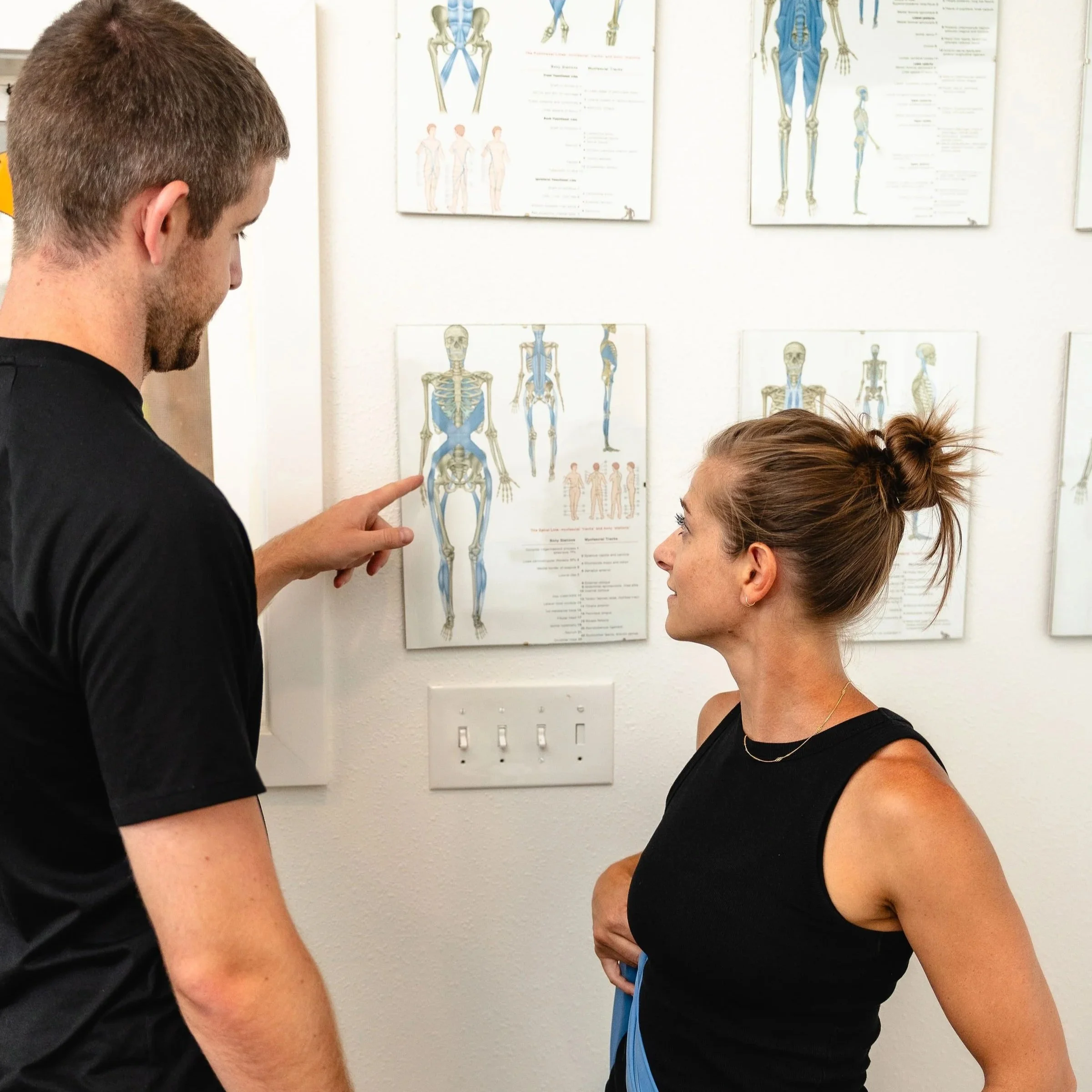
The key to leveraging this very special feature of fascia is understanding fascial chains, their access portals, and how to strategetically ‘wind-up’ and stretch the tissue.
Thomas Myers popularized fascial chains in his book Anatomy Trains in 2014, describing seven different chains of connective tissue that run from tip to toe. Each has its characteristics and function in joint/body stabilization and movement generation.
The Zebrafish Neuro program sets the body up to ‘access’ these different fascial lines through specific positions of the head and shoulder blades.
For example, the Spiral Line is best accessed through the serratus anterior muscle (what we like to call the ‘armpit muscle’) and through upward rotation of the scapula. This position of the shoulder blade increases (good) tone in the oblique abdominals and supports symmetrical seated postures. We find a lot of our SCI athletes have asymmetrical seated posture due to decreased muscle tone on one side of their trunk. The activation of the Spiral Line helps bring their posture back to their midline.
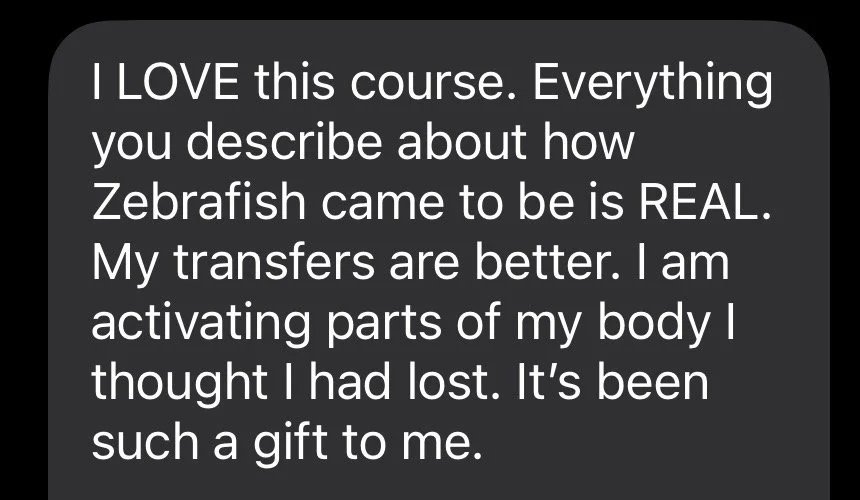
Text from a demonstration client at a recent 3-Day Foundations Course.
Feeling fascia work it’s magic.
Our SCI athletes find that these specific stretch strategies leveraging facial tension give them enough joint integrity for:
Improved wheelchair pushing mechanics.
Decreased low back pain.
Smoother transfers >>>>
The ability to sit up taller
Efficient use of walking mobility aides & improvement in gait (see Case Report here).
Fascial connections give a sense of “body wholeness,” a perception of self that can be challenging when a majority of the body has lost sensation or function after SCI.
I leverage fascial chains and support fascial health in those with:
Clients with low neurological tone (complete SCI) to support stability and joint integrity.
Those who appreciate nuance and precision, which is required for using access portals to fascial lines.
High Tone clients can benefit from a program supporting fascial health and elasticity.
Clients with low levels of sensation, as fascia is a highly sensory organ not directly associated with the central nervous system/spinal cord.
Those with high levels of pain can also benefit from fascial training, as it is highly sensory and associated with pain regulation.
>> Interested in learning more about fascial connectivity? Join me in an upcoming 3-Day Foundations course! ⬇️

4. Safe exploration & kinesthetic feedback from Pilates [equipment]

My very first exposure to anything Pilates was watching a teacher work with a neuro client on a piece of Pilates equipment called a Trapeze Table: springs suspended from a canopy, supporting the weight of the client’s legs while they moved them with such ease in a relatively gravity-free environment.
My mind was blown: I no longer had to bear the weight of my client’s limbs during their “range of motion” hip mobility warm-up!? And that was just the beginning.
Pilates equipment was developed to refine (and support) bodies in their journey to learning complex calisthenics originally done on the Mat. And that’s exactly how we use Pilates equipment for our SCI clients: the equipment offers the perfect balance of support and resistance to allow SCI athletes with limited movement, to move.
Many of our SCI athletes feel that Pilates equipment provides a similar experience to being in the water. In both environments, individuals can explore movement and build strength in positions that otherwise feel too “heavy” in real life.
Pilates uses springs as its primary form of resistance, and in our program, to support.
Any changes in the client’s position, weight shift, or effort are reflected in the springs (this is called dynamic support) - for better or worse! Instead of a rigid piece of equipment or a trainer/therapist holding up the body, the individual must work to keep in balance with the spring’s support. This kinesthetic feedback quickly helps individuals understand their own alignment, weight shifting tendencies, and level of effort through feeling - a much faster way to learn movement concepts vs. verbal cueing from our coaches.
I use pilates equipment with:
Clients I can see in-person! Since the equipment can be tricky to set-up and manage independently.
Clients that enjoy precision, nuance and looking to work into their fascial chains.
Larger bodies that I need help with supporting - taking the load off my own body.
Reformer: advanced clients that need a little extra challenge for their core stability.
Learn more about different pilates equipment and how I use them here, or in my in-person workshop…
Pilates equipment is quickly becoming a part of physical therapy clinics and activity-based-therapy clinics… but do you know how to use it well and safely?
>> Pilates teachers engage in over 500 hours of training to become certified instructors, but you can get the cliff notes & specific adaptations for neuro in my private in-service ⬇️

Pilates Equipment dupes for at-home programs
While we understand not everyone can afford pilates equipment in their homes, we have been able to recreate pilates equipment and the exercises we do on them, at home.
For example, this common seated posture exercise in Pilates can be practiced at home using resistance bands anchored to a point on the wall! Pilates-inspired exercises make at-home recovery programs much more accessible and sustainable for the long term.


5. Full body integration and expression from Bartenieff Fundamentals / Laban Studies

Where the prior three movement systems focus on physiology and movement science, our last system provides an alternative way to discuss and experience movement for those less anatomy-inclined.
Bartenieff Fundamentals is commonly studied in the dance world where form, shape, emotion, expression, and effort drive movement (vs. your glute muscles or spiral fascial line in other systems).
There are a lot of layers to Bartenieff Fundamentals, but the verbal cueing used in the method is most helpful for getting clients out of their heads and into their bodies: moving from feeling and expression vs. direction. For example, instead of asking someone to “roll onto their back,” I might say “pour onto your back.”
For those with high tone and tendencies to co-contract everything in their body when asked to move, the imagery of ‘pouring’ generally promotes relaxation and suppleness, allowing our clients to move more fluidly. What a relief to move freely in a body that’s usually so rigid!
In addition, Bartenieff Fundamentals is always done on the floor - a place where full-body movement is safe and unlimited. Clients usually share how expressively limited they feel in their wheelchairs, while this movement system as a whole allows for the full expansion of their bodies and personalities. This outlet not only supports physical growth but psychosocial development as well.
I use Bartenieff-style coaching with:
Those with High Neurological Tone
Clients who need to process emotion and move through a psychological block.
Clients who need to get out of their head and into their bodies - more improvisational movement.
Clients looking to improve their movement on the floor - rolling over, sitting up, etc.
The results
The exercises we use are simple, building foundational strength and stability from the ground up ensuring that no box is left unchecked.

While our approach does not guarantee individuals with SCI will walk, it does prepare the body for all kinds of complex movements, walking and standing being some of them.
I recently had a client tell us that our approach helped them find the ‘missing link’ in her standing and walking stability, while we did very little of those specific positions in her program. How cool is that!?
With the strategic implementation of exercises in appropriate progressions, Zebrafish Neuro SCI athletes gain confidence in their bodies which inevitably carries into confidence in their lives: school, work, families, and relationships. This element of the recovery process, a return to life, is an important outcome measure to consider when evaluating the success of a program.
Movement heals

While the frontiers of SCI recovery research are exciting, I encourage all SCI athletes and neuro rehab professionals to stay grounded (literally and figuratively) with a foundational program.
While we wait for these advancements to become more available, I encourage SCI athletes to find what movement methods feel best for now and be open to other options as the body and priorities change over time.
The best form of therapy for you at this time might be right under your nose… >>>>
I share more about these systems, along with HOW to use them effectively in my Professional Development Courses.
Check out upcoming events below:
About the Author of this Article
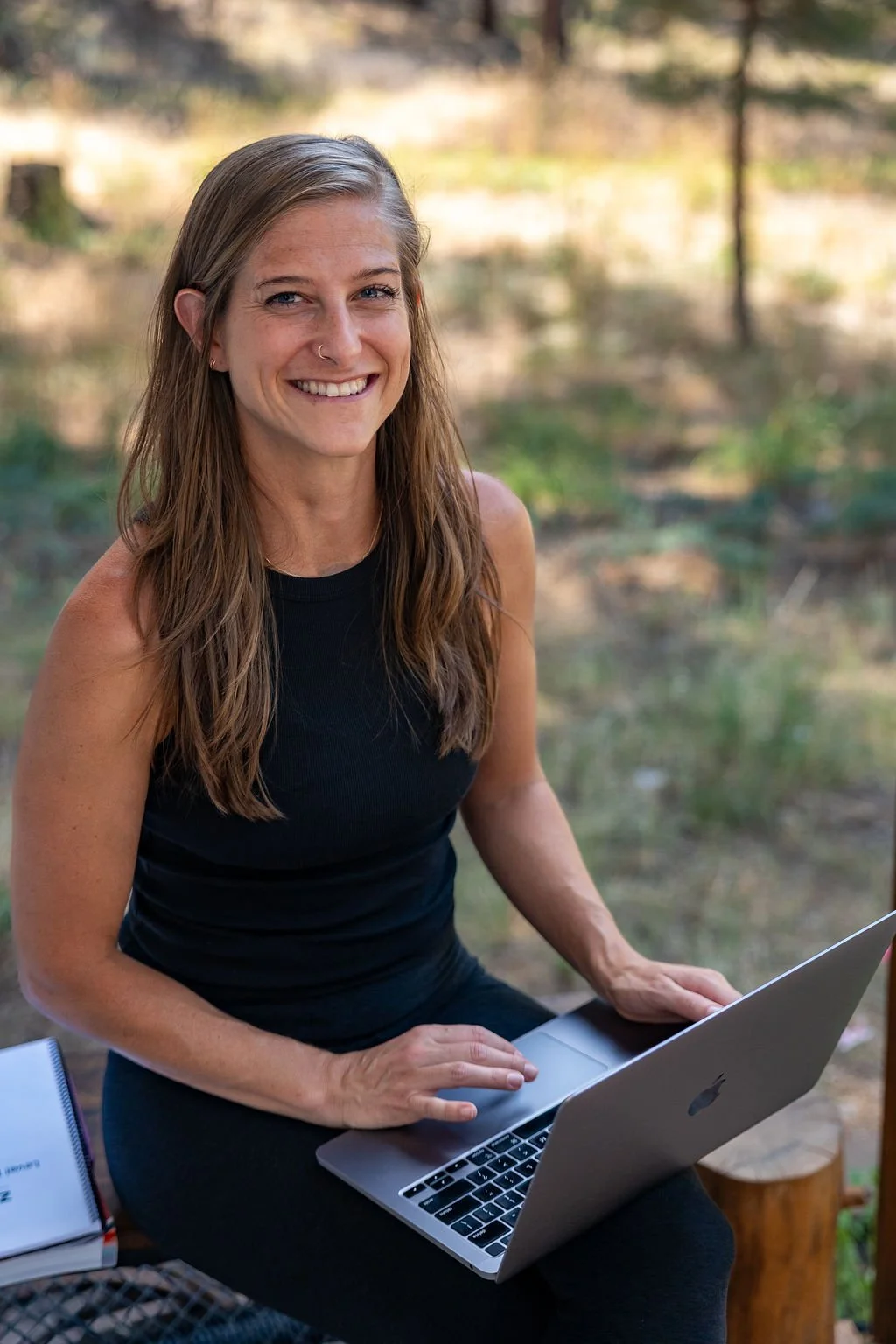
Stephanie Comella
co-founder of Zebrafish Neuro
B.S. Exercise Biology
Nationally Certified Pilates Teacher (NCPT) - specializing in Spinal Cord Injury
Stephanie Comella has been working with individuals with spinal cord injuries since 2011. She blends her formal education in movement science, Pilates, and other mindful movement modalities with neurological science to provide an intuitive, hands-on style of teaching focused on body re-connection. Stephanie aims to empower both individuals with SCI and their trainers using a human-powered healing approach.
You can read her full bio here.
